Fingerprint, MRZ, NFC and Smart Card Readers: What Does Each One Do?

Biometric and identity devices often combine several different readers and sensors. But what does each one actually do?
Fingerprint, MRZ, NFC, and smart card readers serve different purposes. Understanding the difference helps organizations choose the right biometric hardware for identity enrollment, verification, border control, and other applications.

Fingerprint Readers
A fingerprint reader captures the unique patterns found on a person's fingers.
During identity enrollment, the reader captures fingerprints and converts them into biometric data that can be used for identification or verification.
Fingerprint readers are commonly used for:
National ID enrollment
Voter registration
Border control
Law enforcement
Civil registration
Banking and KYC
For government and large-scale deployments, fingerprint quality and certification can be important considerations.
MRZ Readers
MRZ stands for Machine Readable Zone.
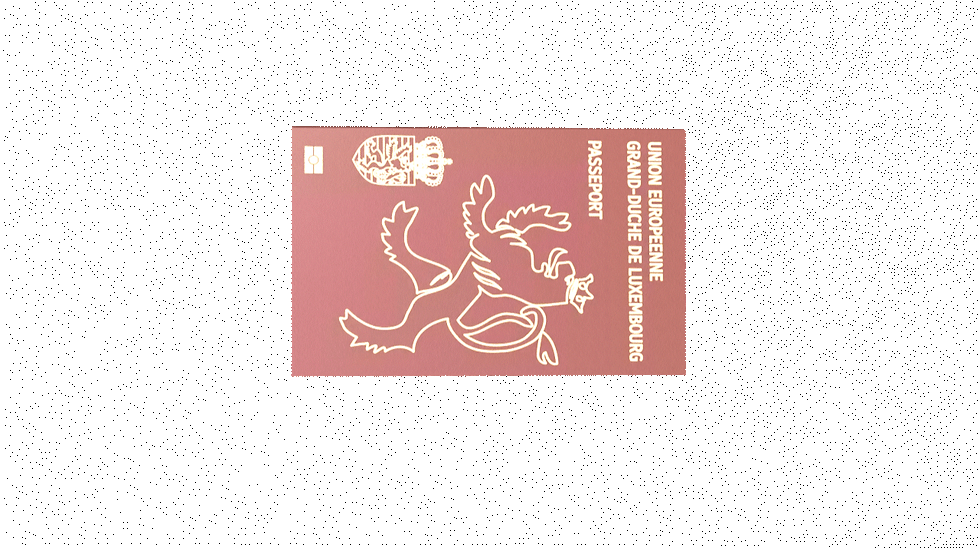
The MRZ is the machine-readable section printed on passports and certain identity documents.
An MRZ reader uses optical technology to capture and decode this information automatically.
It can provide information such as:
Name
Document number
Nationality
Date of birth
Expiration date
Issuing country
MRZ reading reduces the need for manual data entry and can make document processing faster and more consistent.
NFC Readers
NFC stands for Near Field Communication.
Unlike MRZ, which reads printed information, NFC communicates wirelessly with the electronic chip inside compatible passports, ID cards, and other documents.
NFC can be used to access electronically stored identity information and, depending on the document and system, support document authentication.
This makes NFC particularly useful for:
ePassports
Electronic ID cards
Border control
Identity verification
Digital identity applications
MRZ and NFC Often Work Together
MRZ and NFC are not competing technologies.
They can complement each other.
MRZ → reads the printed information
NFC → communicates with the electronic chip
Using both can provide a more complete document-processing workflow.

Smart Card Readers
Smart card readers communicate with cards containing an embedded chip.
Depending on the card and application, the chip can store information used for identification, authentication, access control, or other secure transactions.
Smart card technology is used in applications such as:
Government ID cards
Employee identification
Access control
Banking
Healthcare
Secure authentication
Smart card readers may support either contact cards, where the card physically connects with the reader, or contactless cards using technologies such as NFC.
What Is the Difference?
Technology | Reads / Captures | Common Use |
Fingerprint | Fingerprint characteristics | Biometric identification |
MRZ | Printed document information | Passport & ID processing |
NFC | Contactless electronic chip | ePassports & eIDs |
Smart Card | Embedded card chip | Secure identification & authentication |
Each technology solves a different part of the identity process.
Why Combine Them?
Modern identity workflows often require more than one technology.
For example, an operator may:
1. Scan the passport MRZ↓2. Read the passport chip using NFC↓3. Capture the person's fingerprint↓4. Capture a facial image↓5. Compare and verify the information
Combining multiple technologies can create a more complete identity verification process.

Integrated Biometric Devices
Traditionally, these functions may require several separate peripherals connected to a computer or tablet.
Today, biometric hardware can integrate multiple technologies into a single platform.
BioRugged devices provide examples of this approach.
The Marque 5.1 combines multiple biometric and identity technologies in a compact 5-in-1 platform, while devices such as the BioWolf DEZ and AIO 10 bring fingerprint, document, NFC, smart card, and other capabilities into rugged platforms, depending on configuration.
This type of integration can reduce the number of external devices required and make the solution easier to deploy in mobile and field environments.
Which Reader Do You Need?
There isn't one reader that replaces all the others.
The right combination depends on the application.
For fingerprints: choose a suitable fingerprint sensor and certification level.
For passports: MRZ and NFC capabilities can provide complementary document-reading functions.
For electronic ID cards: NFC and smart card capabilities may be required.
For mobile enrollment: an integrated rugged platform can reduce the equipment operators need to carry.

BioRugged: Integrated Identity Technologies
BioRugged develops rugged biometric devices that bring multiple identity technologies together in a single platform. Depending on the model, BioRugged devices can combine fingerprint capture, MRZ reading, NFC, and smart card reading, helping organizations reduce the need for separate external readers and accessories.
From mobile identity enrollment and civil registration to border control and field verification, BioRugged solutions are designed to bring the necessary biometric and document-reading capabilities directly to the point of operation.
One device. Multiple identity technologies. Built for the field.
Conclusion
Fingerprint, MRZ, NFC, and smart card readers all play different roles in modern identity systems.
Fingerprint readers identify the person.
MRZ readers capture printed document information.
NFC readers communicate with electronic identity chips.
Smart card readers communicate with chip-based cards.
When these technologies are integrated into a single rugged platform, organizations can build more compact and efficient solutions for identity enrollment, verification, border control, national ID, and field operations.
The key is not choosing one technology over another. It's choosing the right combination for the identity workflow.