
Biometric Enrollment vs. Biometric Verification: What’s the Difference?
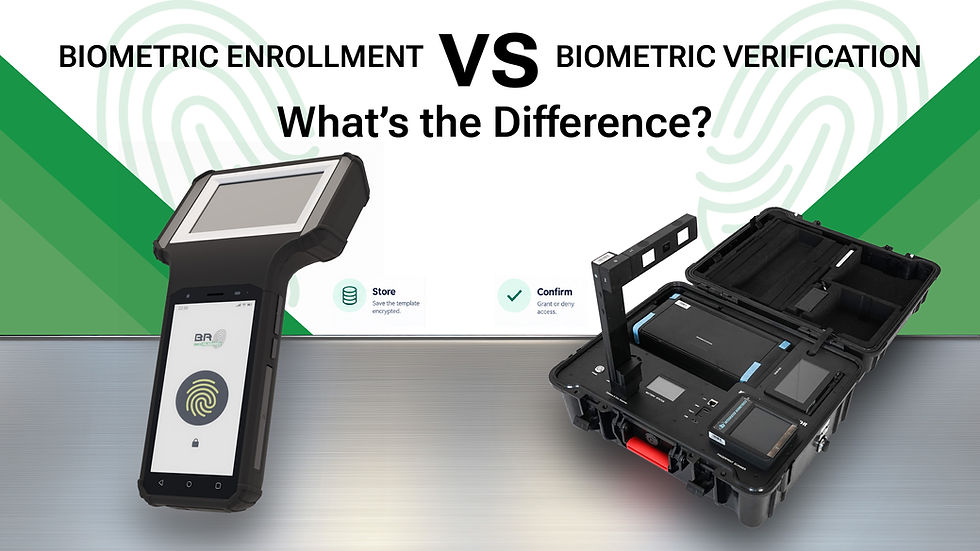
Biometric technology is used in national ID programs, passport applications, border control, voter registration, banking, eKYC, access control, and other identity services. Two terms appear often in these systems: biometric enrollment and biometric verification.
Although closely connected, they describe different steps. Understanding the difference helps organizations plan identity workflows and choose hardware suited to the work.
WHAT IS BIOMETRIC ENROLLMENT?

Biometric enrollment is the process of registering a person and associating biometric information with their identity. During enrollment, an individual's biometric characteristics are captured and connected to personal or identity information. Depending on the program, this may include fingerprints, facial images, iris images, identity documents, demographic information, signatures, or other identity-related information.
For example, in a national digital ID program, an operator may capture a person's fingerprints, facial image, iris data, and demographic information. The information is processed according to the identity platform's requirements. The objective is to create a biometric identity record that can be used later.
Enrollment answers: “Who is this person, and what biometric information belongs to their identity?”
WHAT IS BIOMETRIC VERIFICATION?

Biometric verification is the process of confirming that a person is who they claim to be. Unlike enrollment, it does not normally create a new identity record. A newly captured biometric sample is compared with biometric information already registered.
For example, a person may present an identity document and provide a fingerprint. The system can compare the new fingerprint with the biometric reference associated with the claimed identity.
Claimed identity → Biometric capture → Comparison → Verification result
Verification is commonly described as a 1:1 comparison: the captured biometric is compared with the biometric associated with one claimed identity.

ENROLLMENT VS. VERIFICATION
Enrollment:
• Register an identity • Captured and registered • Registration process
Verification:
• Confirm an identity • Captured and compared • 1:1 comparison
COMMON ENVIRONMENTS
Verification:
Confirming an ID holder's identity • Borders • Checkpoints, • Banking, • Access control • Reliable matching against a claimed identity
Enrollment:
• National ID registration • Government offices • Enrollment centers • Mobile registration • Data quality and completeness
WHERE DOES IDENTIFICATION FIT?
Biometric identification is another term that is often confused with verification. Identification asks: “Who is this person?”
Instead of comparing a biometric sample against one specific identity, the system searches across multiple biometric records for a potential match. This is commonly called a 1:N search. For example, a newly captured fingerprint may be checked against an existing database to determine whether a person already has a registered identity.

Enrollment → Create the biometric identity record

Verification → Confirm a claimed identity

Identification → Search for an identity
WHY ENROLLMENT QUALITY MATTERS

The quality of biometric enrollment can affect the identity lifecycle that follows. Biometric data needs to be captured correctly and consistently. Poor positioning, inadequate lighting, unsuitable environmental conditions, or low-quality capture can affect the resulting record.
This matters in large-scale identity programs, where thousands or millions of people may be enrolled. Operators may need to capture several biometric modalities during one session, such as fingerprints, face, iris, documents, or signatures. Having the required components available within one workflow can reduce the need to move between devices and help create a more consistent registration process.

WHERE DOES BIOMETRIC HARDWARE FIT?
An identity system typically involves software and hardware. The software platform manages processes such as registration, identity management, biometric matching, data processing, and workflow management. Hardware physically captures biometric and identity information.
An enrollment station may bring together fingerprint scanners, cameras, document readers, NFC or smart-card readers, signature pads, displays, tablets or computers, and printers. The exact configuration depends on the program's requirements. Verification hardware may be more compact, focusing on the biometric and identity information needed for a particular workflow.

MOBILE BIOMETRIC ENROLLMENT
Not every enrollment operation takes place in a permanent government office. National identity programs, civil registration projects, voter registration, refugee registration, and other initiatives may require teams to work in different locations.
Mobile biometric enrollment hardware can be transported and deployed where registration is required. Portable kits, rugged tablets, handheld devices, and integrated biometric stations offer different approaches depending on the environment and workflow. Hardware should support the biometric components required by the program while remaining practical for field deployment.
WHERE BIORUGGED FITS
BioRugged focuses primarily on the hardware side of biometric and identity workflows, developing and integrating rugged biometric hardware for identity programs. Its work includes development and technical integration support for platforms such as MOSIP. This places BioRugged at the point where physical biometric capture connects with the identity platform, while the platform manages its own identity workflows.
The hardware and integration approach for a deployment depends on the program's requirements; no single configuration fits every project.

FROM ENROLLMENT TO VERIFICATION
Enrollment and verification are different stages of the identity lifecycle. A person may first be enrolled at a government office or through a mobile registration operation. Later, that biometric identity may be used for verification at a border crossing, financial institution, service point, checkpoint, or another authorized location.
Enrollment establishes the biometric identity record. Verification uses that record to help confirm identity. The hardware used at each stage may differ, but both need to work as part of the wider identity ecosystem.

CHOOSING THE RIGHT BIOMETRIC HARDWARE
When planning a biometric deployment, organizations need to consider more than which sensor to use. Useful questions include:
• Which biometric modalities are required?
• Is the application enrollment, verification, or identification?
• Will the equipment be used indoors or in the field?
• Does the deployment require portable hardware?
• Are document, NFC, or smart-card capabilities required?
• How many operators and users will the system support?
• Must the hardware integrate with an existing identity platform?
• What environmental conditions will the equipment face?
• How will the equipment be powered and transported?
The answers help determine whether a project needs a handheld device, rugged tablet, portable enrollment kit, or integrated biometric station.

THE SIMPLE DIFFERENCE
Biometric terminology can seem complicated, but the basic distinction is straightforward:
Enrollment creates the biometric identity record.
Verification confirms a claimed identity.
Identification searches for an identity.

Each process has different requirements. The hardware supporting it should fit the operational environment and the identity platform being used. Choosing appropriate hardware is an important part of building a practical workflow for a digital identity or biometric program.
BioRugged develops and integrates rugged biometric hardware and provides development and technical integration support for platforms such as MOSIP.


